Yuan's slide no power game
By Antoaneta Bezlova
BEIJING - Recent downward movements of the Chinese yuan have been interpreted in Beijing as political statements aimed at the incoming administration of US president-elect Barack Obama indicating that it should respect China's sovereignty rights on the currency issue.
Obama, when a candidate for the US presidency, accused China of keeping the value of its currency artificially low to protect the competitiveness of its export prices.
"Little concrete results can be expected to be achieved with a lame duck administration," said independent economist Xie Guozhong. "That is why Beijing chose this time to send a strong
signal to the incoming US administration that they need to be more considerate about China's needs to maintain its currency stable."
But there are signs that the yuan's sharp fall last week is more than just a salvo in a tense diplomatic exchange, and that, not unlike the US during the Great Depression, China is trying to export its way out of the economic crisis.
"China can go through its own version of the 1930s' Great Depression," argues Michael Pettis, professor of finance at Guanghua School of Management at Beijing University.
According to Pettis, Beijing's recent moves - increasing subsidies to exporters and halting appreciation of the yuan - bear similarities to the ways the US sought in the 1930s to export its problem of overcapacity.
Beijing exercises heavy control over the yuan's value. While most Asian currencies (except the Japanese yen) have fallen against the US dollar in recent months, the yuan has remained stable.
China gained considerable political credit from its decision during the 1997-8 Asian financial crisis to keep its currency stable and often reminds its neighbors of that effort. Nor have Chinese officials discouraged expectations that they would repeat this feat during the current economic crisis.
But then the Chinese yuan fell by its maximum daily trading limit of 0.5% against the US dollar for two consecutive days last week - the largest such change since China ended its effective peg to the US currency in the summer of 2005.
An editorial in the China Times newspaper was emphatic: "The currency move is a political signal aimed at the Obama administration not to exercise more pressure on China to revalue its currency.''
The sudden and steep fall of the yuan on December 1 came ahead of the latest round of biannual US-China strategic economic dialogue held in Beijing, where US Treasury Secretary Henry Paulson was expected by some economists to raise the heat on his hosts to speed up the appreciation of the Chinese currency.
China has been under immense pressure from its trade partners in the West to allow the yuan to appreciate and thus reduce its huge trade surplus. Over the past two years, China allowed the yuan to gain value relative to the dollar. That process has come at a high price, hitting Chinese exporters who were already struggling with rising costs and slumping global demand.
In mid-November, Zhou Xiaochuan, governor of the People's Bank of China, said that he could not rule out a depreciation of the yuan if the external environment remained tough for Chinese exporters.
His statement was followed by comments by President Hu Jintao that China was in danger of losing its completive edge in trade. Speaking to a regular study session of top Communist party officials, Hu warned that the economic crisis was testing the government's ability to steer the country through simultaneous global recession.
Several weeks ago Beijing announced a stimulus package of 4 trillion yuan (US$586 billion) in government and private-sector spending on public works and social programmes but little of that package is aimed at helping the collapsing exporters.
The yuan's drop came amid signs that the economic slowdown was hurting the country's exports more than had been previously envisaged. In southern China, where the main manufacturing hubs are based, hundreds of factories have gone bust, throwing thousands of workers on the streets.
November trade figures were expected to be released on Wednesday and experts anticipate export growth will be negative.
The Ministry of Commerce's latest trade outlook report warns of more closures amid plunging global growth rates. "The situation will get even more complicated, and there will be more uncertainties in 2009,'' the report said.
Exports have accounted in recent years for about one-third of the country's growth in gross domestic product. Beijing has been trying to shift gears and boost domestic consumption as the new driving force for growth but change has been slow.
In the days after the currency drop, speculation grew that Beijing was going to adopt a long-term weaker yuan policy to try and bail out its struggling exporters.
"There are still several leverages that the government could use to increase exports including the exchange rate," said Pei Changhong, a trade expert, in the "Blue Book of China's Economy", released by the China Academy of Social Sciences.
Commerce minister Chen Deming has rejected suggestions that the drop in the yuan was a deliberate government move to stabilize exports, saying it was due to "purely market forces".
The yuan's value has been a perennial bone of contention between China and its trade partners in the West, particularly the US, which says the low value of Chinese currency has allowed Beijing to grow its economy at the expense of competing countries' manufacturers.
China generates a huge trade surplus of goods and services, which last year accounted for 9% of its GDP. As more and more economies enter recession, Beijing's moves to use currency regime to ward off economic troubles are likely to raise protectionist hackles in more than one country.
"They [the Chinese] can't get away with increasing their trade surplus and exporting their over-capacity," says Pettis. "There would be a wave of anti-China sentiment around the world".
source: asia times
link to the original post:
http://www.atimes.com/atimes/China_Business/JL11Cb01.html
Fort Lauderdale Blog and Real Estate News
Rory Vanucchi
RoryVanucchi@gmail.com
http://waterfrontlife.blogspot.com
www.FortLauderdaleLiving.net
Showing posts with label currency. Show all posts
Showing posts with label currency. Show all posts
Dec 10, 2008
Dec 9, 2008
Three Reasons Why the Dollar's Not Yet Done
by Louis Basenese
Recall, in late March, I predicted here the dollar was overdue for a rally. Ninety-six percent of you cursed me. The other 4% pocketed an easy 20% or so (more if you played the options market).
But after such a swift run - mind you similar moves in currencies typically take years, not months - is the dollar rally finally coming unhinged?
Legendary investor Jim Rogers seems to think so. As he told Bloomberg News in a TV interview, he plans to exit his dollar holdings because he thinks the dollar “will go down a lot” and it is “going to lose its status as the world’s reserve currency.”
To which I simply respond, “Into what Jimbo?” No other choice for a reserve currency exists. No matter how much other governments wish it were so. The euro is frequently mentioned. But it’s depreciating in value. And there’s not enough liquidity to handle the demand. Plus, it’s still a prepubescent, experimental currency, not one governments can invest in with 100% faith.
Moreover, with two-thirds of foreign reserves already in dollars, it would take more than eight years to replace the dollar as the currency of choice.
So once again, I’m striking out on my own. (And I’m ready for the flood of fan e-mails.) While many pundits would like you to believe that the dollar rally will be short-lived, I completely disagree.
The dollar’s not done.
Today I offer up three more reasons why. And of course, three ways to play it.
Too Far, Too Fast? Hardly…
Keep in mind, currency rallies tend to be measured in years and months. Not weeks and days. In fact, according to Bespoke Investment Group, the average dollar rally lasts 489 calendar days. The longest rally on record lasted roughly 10 years.
While I don’t think we’re in store for a historic run this time, I do think the current rally has more legs (about another year based on the averages out of Bespoke).
Aside from no alternative world reserve currency, here are three more fundamentals in defense of the dollar:
Further Interest Rate Cuts
Foreign governments bought into the farce that was decoupling. As a result, they remained hawkish for way too long, keeping interest rates too high, at a time when they should have been cutting them to stimulate growth. And now they’re scrambling to catch up. They must make growth their first priority. So further interest rates cuts are inevitable, narrowing the gap with U.S. interest rates. And before long, perhaps the middle of 2009, we could be raising rates while other countries are still lowering.
Continued Deleveraging
As Mark Astley, CEO of Millennium Global Investments, a U.K.-based currency manager, notes, “there is a pyramid of leverage” in the financial markets that will take considerable time to unwind. The half-frozen credit markets are only slowing down the process. As they thaw out completely, expect hedge funds and foreign banks to keep buying up dollars.
Uncertainty Reigns
Despite a new president, uncertainty remains in the markets. Or as UniCredit wrote in a recent research note, “We do not expect global recession fears to wane considerably.” And during times of fear and risk aversion, the dollar tends to outperform.
Bottom line, the current rally has plenty of room to run. If you dare to be contrarian, here’s how I recommend you play it.
Consider Pure Plays
For a pure play on the U.S. dollar - without trading the currency markets - I recommend the PowerShares DB US Dollar Bullish Fund (UUP). It’s designed to replicate the performance of being long the greenback against the euro, Japanese yen, British pound, Canadian dollar, Swedish krona and Swiss franc.
Another strong choice is the EverBank* DollarBull CD. Available in 3-, 6-, 9- and 12-month terms, it offers potential appreciation in the U.S. dollar against a selected foreign currency. If you opt for the latter, I recommend going long the U.S. dollar versus the euro.
Take Profits on Unhedged Multinationals
Consider taking profits in multinationals with significant foreign currency exposure. I say that because the rapidly strengthening dollar will dent future earnings in two major ways. First, because profits earned abroad will be worth less, as they’re translated back into dollars. Second, because demand for the company’s products will drop off, as they will be more expensive to foreign buyers. We’re already seeing this double-whammy hurt third-quarter results for some big multinationals. But if the dollar holds its ground, or strengthens further, the impact will be much more dramatic in the fourth quarter. So get out while you’re ahead.
Buy American
While the dollar was plummeting, it made sense to buy companies with significant international sales. They provided a nice currency hedge. However, a strong dollar means we need to reverse course and seek out companies with zero (or minimal) international revenues. I’d stick to solid companies in the utility, health care and consumer staples industries, as demand will remain steady no matter how long the recession lasts.
In the end, I know my dollar stance is contrarian. Or as many of you put it last time, “ignorant” and “completely out of touch.”
I’d add “profitable” to that list now. And I don’t expect this time to be any different.
*Disclaimer: The publisher of Investment U maintains a marketing relationship with EverBank, but it’s important to note that we’d recommend their products and services anyway.
source: seekingalpha.com
link to the original post:
http://seekingalpha.com/article/108259-three-reasons-why-the-dollar-s-not-yet-done?source=commenter
Fort Lauderdale Blog and Real Estate News
Rory Vanucchi
RoryVanucchi@gmail.com
http://waterfrontlife.blogspot.com
www.FortLauderdaleLiving.net


Dec 7, 2008
Will We Reach 4 RMB Per U.S. Dollar?
Though this title may be extreme to some readers, it is provocative on purpose. The dollar has appreciated 30 to 54 percent against most of the world's leading currencies over the last few months. Recently, 1.0 Euro was equal to 1.6 USD, now it is traded at 1.3USD. Similarly, 1.00 USD was equal to 1.03 Australian dollars; it currently is traded at 1.59 AUD.
The fact that something appears to be an extreme scenario does not necessarily make it unreasonable. In the economy there are cycles that canrepeat. A lack of balance is built gradually. When change happens gradually, people slowly become accustomed to it, soon accepting the new status quo without question.
Macro economic problems can not just be swept under the carpet, hoping that no one will notice. Over the last few months, many Americans are converting foreign currencies from countries such as Australia, New Zealand, Britain, Brazil and Turkey into US Dollars. The US dollars appreciated against the Euro 26%, the Australian dollar 54% and the British pound 30%. In the long term this will have to change; this article seeks to elaborate on the reasons why.
Why can't the American trade deficit continue to grow forever?
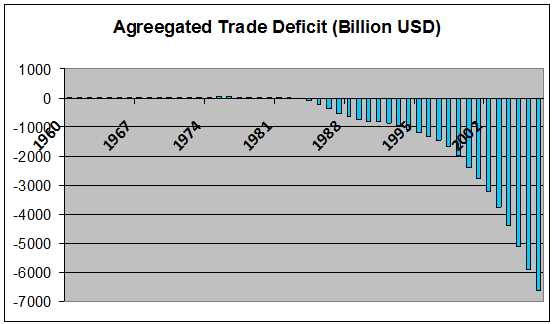
Until the 80's America had a surplus in its trade balance with most countries. Starting from the early 80's the trade balance began to change and the US economy shifted from a surplus to a deficit. In 2000, when the hi-tech bubble burst, federal banks tried to stimulate the economy and artificially encourageAmerican consumption by lowering interest rates and borrowing money from China, Europe and Japan to finance the trade balance deficit. The result is that American debt is now over 11 trillion dollars – almost 100% of the GDP of the US. This is similar to countries like Argentina and Turkey, significantly worse than most OECD countries.
In the following graph we can see how the American trade deficit was at almost zero in the 80's, jumping over the last 30 years to a significantly high proportion of the GDP.
Why is American trade deficit bad for the global economy?
This process of borrowing money from Europe, China and Japan is similar to that of an ordinary family in New York (say the Smith family) borrowing money from its bank over 30 years to buy property. Eventually their debt becomes more than the family's annual income. The Smiths will ultimately have to pay back the bank or it will begin foreclosure procedures.
This is exactly what will happen between the US and Europe, China & Japan; the Americans will have to pay it back. There is only one way to do so: stop lending money and start returning money by reducing imports and increasing exports.
Why is a weak USD necessary to decrease the American trade deficit?
American exports need to grow and imports must decline until the trade balance normalizes in order for debt to decrease.
Let's look at an American software exporter (The American Company) as it aims to sell its software in Europe, China and Japan. Let's say that average software is now being sold for 1,000 USD (6,800 RMB). If the dollar / RMB exchange rate depreciates to 4.00 the actual software price will still maintain 6,800 RMB price but in USD it will become 1,700 USD. This will generate The American Company higher revenues in USD, while costs remain the same. In addition, it will be able to compete better with Chinese and European Software developers, thus contributing to an increase in exports.
On the other hand, let's look at a toy manufacturer from Guangzhou, China that now receives 10USD for the average item it exports to the United States. Say that the cost is now 8USD (54 RMB). If the exchange rate is reduced to 4.00, the revenue per item drops to 40RMB, thus making it impossible to export to the US. The exporter will need to shift its focus to Europe, other markets in Asia and of course, Chinese consumers. Exporting toys to the US will no longer make sense, enabling local American toy producers to compete better in American local markets.
The final outcome would result in China importing more goods and services from US companies, while trying to divert some of their exports to countries where their currency is stronger. This would mean higher American exports, lower imports, thus lower debt. In this light, creating a weak dollar is the only remedy to treat the rising trade deficit.
Only time will tell, but by 2013 we could expect the following exchange rates:
Currency | Current exchange rate | Exchange rate (January 2008) | Change (last 3 months) | 2013 predictions | Expected change until 2013 |
RMB | 6.84 | 6.85 | 0% | 4 | -42% |
Yen | 115.00 | 96.00 | -17% | 65 | -32% |
AUD | 1.03 | 1.59 | 54% | 1 | -37% |
GBP | 0.48 | 0.62 | 30% | 0.4 | -35% |
Euro | 0.63 | 0.79 | 26% | 0.5 | -37% |
YTL | 1.16 | 1.68 | 45% | 1 | -41% |
This represents a USD average decline of 40% when viewed in comparison to a few major and emerging market currencies. If one is considering investing in American stock or bond markets, one must take this into consideration. In estimation, this trend would be gradual, but in reality foreign exchange market can react very quickly, thus affecting the overall the speed of this transition.
source: seekingalpha.com
link to the original post:
http://seekingalpha.com/article/109540-will-we-reach-4-rmb-per-u-s-dollar
Fort Lauderdale Blog and Real Estate News
Rory Vanucchi
RoryVanucchi@gmail.com
http://waterfrontlife.blogspot.com
www.FortLauderdaleLiving.net
Dec 1, 2008
Several Countries Are Rethinking the Euro
COPENHAGEN — The deepest financial crisis since the Great Depression has prompted countries that had snubbed the euro to take a fresh look at the virtues of the common European currency.
After turmoil in the currency markets nearly destroyed the Icelandic krona and undermined the Polish zloty, those two countries are rethinking their opposition to the euro. More surprisingly, Denmark — a nearly picture-perfect model of economic management — looks more likely to embrace the euro, after rejecting it twice in the past.
Denmark was forced to use high interest rates to defend its currency, the krone, against speculative attack. The effects of those higher rates are now rippling through the Danish economy, contributing to achange in attitudes.
“Denmark is so extremely sound by all macroeconomic standards,” said Thomas Mirow, president of the European Bank for Reconstruction and Development. Its changing stance on the euro “says a lot about stand-alone options in difficult times.”
After 10 central and eastern European countries joined the European Union in 2004, the political will to control budget deficits and inflation — the two key criteria for adopting the euro — melted away.
As a result, only four small countries — Slovenia, Cyprus, Malta and Slovakia — have qualified for the euro. But the financial crisis has changed the situation in a few furious months, as the newly visible costs of not using the euro recast the politics of independent currencies.
At its core, the convulsions in financial markets encompass a “flight to quality,” the term investors use to describe a sudden shift of money out of potentially risky assets into the safest possible assets, one of which has been the euro, and investments denominated in euros.
This dynamic has played out quickly.
In late October, the Polish zloty fell sharply in value against the euro as markets fretted that the economic crisis gripping Hungary would spread to neighboring Poland.
That focused minds within Law and Justice, the rightist nationalist party to which the Polish president, Lech Kaczynski, belongs. The party has long demanded that Poland hold a referendum on the euro, believing it would fail.
But the zloty’s depreciation suddenly threatened a swath of the party’s voters who had taken out euro-denominated loans, analysts said. While these loans came at attractive interest rates, a weaker zloty threatened Polish borrowers with higher mortgage payments.
Within a few days, Mr. Kaczynski agreed to a plan for adopting the euro by 2012, and quietly dropped demands for a plebiscite. A few weeks later, Poland reached an agreement with the European Central Bank on a currency swap line of 10 billion euros to tide it over during the crisis. The zloty stabilized.
“ ‘When there’s a threat, find God,’ goes the proverb in Poland,” said Rafal Antczak, an economist at Warsaw University. “And that is what has happened.”
Latvia, Lithuania and Estonia, which also joined the European Union in 2004, have never needed convincing about the euro’s merits, but they are redoubling their efforts to ensure that they can join within a few years. Hungary, which got its own assistance from the European Central Bank, is also shifting toward the euro. And Sweden, which also belongs to the European Union but voted down the euro in 2003, has seen a shift in public sentiment.
Iceland, an island nation of 300,000, teetered on a national bankruptcy before securing a lifeline from the International Monetary Fund. The Icelandic krona’s free-fall of nearly 80 percent against the euro made the country’s banks, which had heavy liabilities in other currencies, insolvent almost overnight. Iceland has long rejected membership in the European Union, a prerequisite for adopting the euro, because it feared the bloc’s common fisheries policy would strip it of control over a vital natural resource.
Now facing a painful recession, polls show that 60 to 70 percent of Icelanders favor joining the European Union and abandoning the krona. The governing party is reconsidering its opposition.
Major companies in Iceland are already moving to make the euro a reality. Alfesca, a seafood company, and Straumur-Burdaras, an investment bank, now plan to list their shares in euros, eliminating the risk to foreign investors of owning a krona-denominated asset.
“When you have a crisis like this — both a banking and currency crisis — that can only strengthen the call for changes,” said Finnur Oddson, managing director of the Iceland Chamber of Commerce. ”There is a general agreement that our current monetary policy does not work, to put it very politely.”
Denmark will be the acid test for the euro’s appeal, analysts agree, if only because the country has already rejected the common currency in two referendums, the most recent in 2000. Prime Minister Anders Fogh Rasmussen has seized the moment to announce plans for a third referendum, near the end of his center-right government’s term in 2011.
The main obstacle to joining the euro zone, however, is still very much political. The Socialist People’s Party, the main opposition group, has long opposed adopting the euro, saying that the European Union needs to pay more attention to popular causes like curbing speculation and making agricultural policies more environmentally friendly.
The party’s continued opposition would probably sink the referendum, since the margin of support is thin. In November, a poll taken by the Danish statistical agency showed that proponents of the euro had a 49 to 45 percent lead over opponents after a long period of lagging behind.
But Villy Soevndal, chairman of the Socialist People’s Party, has dangled the possibility that it might support the euro if Mr. Rasmussen can get the European Union to take action on the issues it holds dear. Soevndal may be simply bleeding his political opponent, many people in Denmark say, but for the first time since the euro was created, a Danish yes looks tantalizingly possible.
“We get to decide whether Danes vote yes or no,” Mr. Soevndal said. ”We don’t want to play our cards without getting anything.” In order to stabilize trade with the 15-nation euro zone, which is Denmark’s largest trading partner, the Danish central bank keeps the kroner fluctuating in a narrow band against the euro. Since the euro was created in 1999, that has meant adjusting interest rates in lockstep with the European Central Bank.
As the Danish debate over the euro has gathered steam, supporters of the common currency have come to believe that they can bank on a new set of voters: the young Danes who have traveled widely and experienced the benefits of the euro. At the time of the last referendum, euro cash and coins had not yet been introduced.
Marie Petersen, a student and part-time waitress, said her year studying in Spain convinced her that she would rather have euros in her pocket than Danish kroner.
“You can see how it works in other countries,” Ms. Petersen, 21, said. “That’s a big difference from last time.”
source: nytimes.com
link to the original post:
Several Countries Are Rethinking the Euro
Fort Lauderdale Blog and Real Estate News
Rory Vanucchi
RoryVanucchi@gmail.com
http://waterfrontlife.blogspot.com
www.FortLauderdaleLiving.net
Nov 29, 2008
Yen Advances Fourth Month Against Euro as Carry Trades Unwind
Nov. 29 (Bloomberg) -- The yen gained for a fourth straight month against the euro, the longest wining streak since 1999, as the deepening global economic slump prompted investors to sell high-yielding assets and pay back loans made in Japan.
The euro weakened against the dollar for a fifth month as investors added to bets the European Central Bank will cut interest rates next week after inflation in the region slowed by the most since at least 1991. Russia’s ruble declined against the dollar to the weakest level since March 2006 as the central bank let the currency depreciate and raised interest rates to halt an exodus of foreign capital.
“The yen is still our favorite currency,” said Derek Halpenny, head of global currency research at Bank of Tokyo- Mitsubishi Ltd. in London in an interview on Bloomberg Television. “The interest-rate differential argument is still very, very powerful for the Japanese yen as yields around the world continue to plunge. Past performance tells you that the Japanese yen is going to be the currency that outperforms.”
The yen gained 3.4 percent to 121.22 per euro, from 125.30 at the end of October. The currency advanced 3.1 percent this month to 95.52 per dollar, from 98.46. The euro dropped 0.3 percent to $1.2691, from $1.2726 on Oct. 31.
The ruble slumped as low as 27.99 per dollar yesterday, the weakest since March 2006, as the 63 percent drop in crude oil prices from a July peak erodes the country’s export revenue. The currency declined 3 percent against the dollar and the euro this month.
Russia, India
Bank Rossii widened the ruble’s trading band yesterday for the second time this week by about 30 kopeks (1 U.S. cent), or 1 percent, on each side, according to Mikhail Galkin, head of fixed income and credit research at MDM Bank in Moscow. The central bank said yesterday it will raise its benchmark refinancing rate to 13 percent from 12 percent to help stem currency losses.
India’s rupee fell yesterday the most in two weeks, losing 1.4 percent to 50.1075 per dollar, after terrorist attacks across Mumbai left at least 124 people dead. The rupee lost 1.3 percent this month.
The Thai baht dropped to 35.56 per dollar yesterday, the lowest level since February 2007, after the government declared a state of emergency at airports in Bangkok, which were seized and shut by anti-government protesters this week. It lost 1.2 percent this month on concern political unrest will slow growth in Southeast Asia’s second-largest economy.
Banks Rate Cuts
Japan’s currency strengthened 9.4 percent against the New Zealand dollar this month, 7.8 percent versus the British pound, and 5 percent against the Australian dollar as investors pared carry trades in which they buy higher-yielding assets with funds borrowed in low-interest-rate countries. The Bank of Japan’s 0.3 percent benchmark rate is the lowest among developed nations.
The Reserve Bank of Australia will lower its main interest rate three quarters of a percentage point to 4.5 percent on Dec. 1, and the New Zealand central bank will cut its key borrowing costs to 5 percent from 6.5 percent two days later, according to the median forecast of economists surveyed by Bloomberg News. The Bank of England will reduce its benchmark lending rate one- percentage point to 2 percent on Dec. 4, according to a separate forecast.
The euro fell 1.5 percent to 82.52 pence yesterday, the biggest drop since June 3, 2001, after the European Union statistics office in Luxembourg said inflation in the region slowed to 2.1 percent in November from 3.2 percent in October. A separate report showed unemployment in the region rose to 7.7 percent in October from 7.6 percent in September, the highest level since January 2007.
‘Least Resistance’
Investors added to bets the ECB will cut its main refinancing rate about 75 basis points by March from 3.25 percent. The implied yield on three-month Euribor futures contracts expiring in March fell to 2.67 percent yesterday, from 3.15 percent at the end of October. The yield averaged 16 basis points above the ECB’s benchmark over the past year.
The ECB will cut its benchmark lending rate by half a percentage point to 2.75 percent on Dec. 4, according to the median of 56 economist forecasts in a Bloomberg News survey.
“The ECB has to come to the party, and they have to be aggressive cutting rates,” said Lane Newman, a director of currency trading at ING Financial Markets LLC in New York. “To buy the dollar is the path of least resistance. You’d better be prepared for a worse-than-expected time ahead.”
‘Addition Downside’
The ICE’s Dollar Index, which tracks the greenback against the euro, the yen, the pound, the Canadian dollar, the Swiss franc and Sweden’s krona, climbed to 88.463 on Nov. 21, the highest since April 2006. Investors sought refuge in Treasuries from a global recession, sending the yield on two-year notes below 1 percent on Nov. 20, the lowest since regular sales began in 1975.
The Federal Reserve said on Nov. 25 it will assign $800 billion in new funding to bolster credit flows to homebuyers, consumers and small businesses and will take on credit risk by buying debt.
Investors should buy the euro versus the greenback because repatriation of U.S. investments abroad and demand for dollar funding is waning, according to Bank of America Corp.
The Fed’s support of financial markets will flood the economy with excessive dollars, creating “additional downside risks” for the U.S. currency, strategists David Powell and Robert Sinche wrote in a research note yesterday.
“The recent advance of the dollar rests on a weak foundation,” Powell and Sinche wrote. “The rapid expansion of a country’s monetary base should prove to be inconsistent with a strengthening of its currency.”
The dollar may weaken to $1.4180 per euro, a 50 percent retracement of its rally from a record low of $1.6038 in July to a 2 1/2-year high of $1.233 in October, they wrote.
source: bloomberg.com
link to the original post:
http://www.bloomberg.com/apps/news?pid=20601085&sid=a9JVPUiibGq0&refer=europe
Fort Lauderdale Blog and Real Estate News
Rory Vanucchi
RoryVanucchi@gmail.com
http://waterfrontlife.blogspot.com
www.FortLauderdaleLiving.net
Fears That a Weakened British Pound May Grow Weaker
LONDON — Could the British government’s plan to borrow and spend its way out of a recession lead to a run on the pound?
George Osborne, the Conservative Party’s spokesman on such matters, warned of just such an outcome this month, and Peter Mandelson, the Labor government’s business secretary, accused him of being “reckless and irresponsible.”
In the last few days, Mr. Osborne again accused Prime Minister Gordon Brown of driving Britain toward bankruptcy, but he avoided any mention of what one of the biggest borrowing surges in British history might do to its already fragile currency.
All the same, a feeling is building that Mr. Osborne may have a point. The pound, already down more than 26 percent from its high of $2.11 a year ago, could fall further once the economy begins to feel the strain from the increased debt.
“Any economy with our level of borrowing and our deficit of trade should have one of the world’s weakest currencies, not the strongest,” said Peter K. Hargreaves, chief executive of Hargreaves Lansdown, an independent brokerage firm in Bristol. “We don’t make anything anymore, and our biggest export was the City of London, which is in disarray. We are in a very poor state.”
Mr. Hargreaves sees the pound falling to $1.25 — it was at $1.54 on Friday — and he has recently moved £20 million into United States Treasury bills and instruments denominated in, among other currencies, the Norwegian krone.
“I just don’t think this country understands how serious the problem is,” he said.
Britain has a deep, emotional connection with its currency, the world’s oldest still in use. Crashes, when they come — as they did in 1967, 1976 and 1992 — have been viewed as moments of wrenching national shame.
The pound’s buoyant decade under Mr. Brown’s predecessor, Tony Blair, came to be seen as a lush emblem of Britain’s financial and popular resurgence. Middle Eastern and Russian billionaires accumulated British assets, and American investment bankers, once happy to be paid in dollars, schemed to see how they might manage to secure their bonuses in pounds.
Now, unemployment is rising, house prices are falling and economic growth is a faraway hope. Britain is seen as having relied too much on volatile sectors like housing, finance and retail. The numbers paint a stark picture: Britain’s public debt is expected to double to more than £1 trillion by 2012 — or about 60 percent of its gross domestic product.
Still, when it comes to the currency — the ultimate barometer of an economy’s health and future prospects — few forecasters have predicted an outright collapse. In fact, after touching a recent low of $1.48, the pound has rallied, lifted by the government’s stimulus plan, which includes cuts in the sales tax and £3 billion in capital spending. Government officials said in the last week that the steep income tax increases built into the program, aimed at high earners, were there to assure currency markets that these high debt levels would not be permanent.
According to Bloomberg News, the average forecast by City economists for the pound at the end of 2009 is $1.62. It is $1.66 for 2010.
Of course, currency forecasting in the midst of a historic financial crisis is an imprecise art. And such estimates do not square with a growing pessimism about the pound’s future that can be readily heard from the salons of West London to the trading desks of investments banks, where a popular bet has become when, as opposed to if, the pound might hit parity with the dollar.
The last time sterling came close to parity was February 1985, when the currency dipped below $1.10, with Britain hobbled by labor unrest and a recession.
“Parity is not impossible,” said Theo Casey, an investment strategist at The Fleet Street Letter, a financial newsletter that has been forecasting the collapse of the pound since August. “We are this tiny island dependent on finance and housing. We are crashing and it will continue.”
His newsletter foresees a return to past sterling crises, most notoriously the one in 1976, when Britain had to seek a bailout from the International Monetary Fund. According to Mr. Casey, such dire prognostications have hit a chord: newsletter subscriptions have risen more than 30 percent since its call on sterling.
Willem H. Buiter, a political economist at the London School of Economics, points out in his widely read blog, Maverecon, that there are two factors in this crisis that were missing during previous sterling reversions.
The first is that the pound now floats freely, making it more vulnerable to the whims of speculators. The second is the added burden of a devastated banking sector.
These elements are joined by the one common cause of past currency panics: a bet made by currency speculators that the highly leveraged British state will become insolvent.
“A sterling crisis would not be something highly unusual, if your idea of the distant past is not the market trader’s last month,” Mr. Buiter wrote recently, voicing sympathy for Mr. Osborne’s warning that the Labor plan might ruin the pound.source: nytimes.com
link to the original post:
Fears That a Weakened British Pound May Grow Weaker
Fort Lauderdale Blog and Real Estate News
Rory Vanucchi
RoryVanucchi@gmail.com
http://waterfrontlife.blogspot.com
www.FortLauderdaleLiving.net
Subscribe to:
Posts (Atom)

 Posts
Posts


