Showing posts with label world. Show all posts

Nov 10, 2008

Does a bigger boom imply a bigger bust?

For the US housing sector – and the financial firms that financed the boom – a bigger boom meant a bigger bust. Home prices rose higher than before — and now are falling fast.

Shipping too. The Baltic dry index rose high on the back of Chinese demand. And recently it has fallen even faster than it rose.

The Baltic index tracks the cost of shipping bulk goods. But it is indicative of the broad contraction in global trade that is almost certainly now underway. No wonder that China is now pondering the risk that its export boom could turn into an export bust. Its export boom was comparable in scale to the United States housing boom. Perhaps bigger – as it also drew on demand fueled by Europe’s housing boom (and, until recently, the RMB’s large depreciation v the euro) as well as US demand.

Whatever the cause, China’s exports have grown steadily larger over the past few years. Indeed, as the following chart shows, it is almost impossible for words to do justice to the scale of China’s export boom.

Yes, the pace of nominal export growth has slowed recently. But that is largely the result of a bigger base – not any major slowdown. Real export growth has slowed more than nominal exports. But real export growth – despite the loud complaints of the textile sector – has remained positive so far this year. The basic story of this decade – at least until now — is of an enormous boom. There isn’t even much volatility.

Particularly relative to say the 1990s. Back then the pace of growth was generally slower and – as importantly — periods of rapid export growth were followed by periods of no growth. This shows up clearly in a chart that looks at the 12m change in exports (exports in the most recent 12ms – exports in the preceding 12ms).

In the 1990s, Chinese export growth looked rather cyclical. In this decade though exports basically just kept growing and growing.

That though is almost certainly changing. My measure of export growth picks up long-term trends, but not short-term changes. If CLSA’s purchasing managers’ survey is right, there is no little doubt that China’s manufacturing sector is heading toward a recession. Real export growth almost certainly will slow sharply in the fourth quarter.

And — as many have noted — there is a significant risk that domestic investment may slow along with exports. Some investment was directed at building up the export sector; even more likely went into China’s domestic property market. The scale of any slump in investment really matters. China’s investment boom was a bigger source of China’s growth this decade than China’s export boom.

China’s policy response is directionally right. A large domestically oriented stimulus is exactly what is needed. $585 billion is over 10% of China’s GDP – so it is large. At least it if it is really new money.

Unfortunately, as the FT’s Geoff Dyer notes, that isn’t clear yet. If the stimulus is mostly just funds that China would have spent in any case, its actual impact will be modest. But if it is real new money, it could be large enough to make a difference.

The big question though is whether it can be put into effect quickly enough to offset the likely downturn.

It isn’t totally inconceivable that the y/y increase in China’s exports could go from over $250 billion to something close to zero …

China’s financial sector doesn’t rely on financing from the international banking system. That leaves it in a better position than other emerging economies. On the other hand, China has relied more than most on external demand to support its growth – which is a problem in a global context when external demand is disappearing. Let’s hope China can reorient its economy quickly …

UPDATE: A superb leader on China from the FT.

American military cemeteries in Europe honor heroes in both world wars

U.S. military cemeteries in Europe


At Henri-Chapelle in Belgium, Meuse-Argonne in France and Sicily-Rome, countless tombstones tell the stories of those who gave their lives in battle.

By Susan Spano, REPORTING FROM VERDUN, FRANCE
11:35 AM PST, November 06, 2008

On Veterans Day, Americans are asked to do something for the country besides voting and paying taxes: We are enjoined to think of those who fought in faraway places -- the Philippines, North Africa, Europe, Vietnam and Iraq.

Most of them came home, but some did not, even in death. The remains of more than 120,000 war dead rest in American military cemeteries abroad, beneath rows of white marble crosses and Stars of David. Many of the graveyards, including 20 in Western Europe, lie on or near the battlefields where U.S. military personnel fought and fell.

Meticulously maintained by the American Battle Monuments Commission, a small federal agency mandated by Congress in 1923, the cemeteries are profoundly beautiful and meaningful places. Mostly, they're visited by relatives and veterans, but occasionally an American tourist happens by a gate where the Stars and Stripes fly, turns in and sees the massed graves of American heroes who sleep on foreign soil.

That is how I found the American cemetery in the Grand Duchy of Luxembourg earlier this year, where I sat on the freshly cut lawn near the graves of two brothers, wondering how they died and what they would have done if they had survived.

Last month, anticipating Veterans Day this Tuesday, I sought out military cemeteries in Belgium, France and Italy, where thousands of American World War I and II combatants were buried and many more of the missing are remembered.

At the Henri-Chapelle, Meuse-Argonne and Sicily-Rome cemeteries I found as many stories as there are tombstones.

Henri-Chapelle American Cemetery and Memorial

As I drove from Brussels to the hamlet of Henri-Chapelle early one fall morning, armies of commuters clogged the freeway, heading east toward the Belgian capital along the route taken by the German blitzkrieg of May 1940.

An hour later, I arrived in Liege, then turned onto a road that followed a ridge above the placid farmland around the Belgian-German border with its spotted cows, hydrangeas and housewives gossiping at the mailbox. Eastern Belgium, in general and quiet, and lace-curtained Henri-Chapelle, in particular, seem unlikely places for a war.

On the road into town I saw a monument to 1,223 men from the U.S. 1st Infantry Division -- widely known as the Big Red One -- who made it through D-Day but died nearby in late 1944. The Big Red One liberated villages in the area, and locals still remember it fondly.

The 57-acre Henri-Chapelle cemetery has an airy setting atop the ridge just outside the village, flanked by rhododendron bushes that bloom in the spring.

Safely behind the line of advance, Henri-Chapelle began functioning as a temporary graveyard as early as September 1944, and at first had as many enemy as Allied burials, though the Germans were later moved and about 60% of the American dead were returned to the States.

Now, 7,989 military personnel are buried at Henri-Chapelle. Most died when the Americans first breached the German border around the town of Aachen and, a few months later, in northern sectors of the pivotal Battle of the Bulge.

In front of a large map in the memorial, Dwight Anderson, the assistant superintendent, briefed me on fighting in the region and showed me the nearby tablets of the missing. Rosettes marked some names, indicating that their remains were later found.

Six decades after the war, the job of finding and burying the dead continues. Anderson told me that a few weeks earlier the remains of two soldiers from the 28th had been found in eastern Germany.

Anderson's knowledge about the war is encyclopedic. "Just hit my pause button when you get bored," he said. But I never did.

From the bare facts on a tombstone he could guess where the soldier fought and possibly even how he died. He treated headstones like old friends: 15 men killed when the Remagen Bridge over the Rhine River in Germany collapsed on March 17, 1945, and scores of the 28th and the three Tester brothers from Tennessee lying side-by-side.

Anderson isn't the only one in the area with a long memory. Near the village of Thimister-Clermont, Belgium, also in Liege province, Mathilde and Marcel Schmetz have created a war memorial of their own, the Remember Museum 39-45. It's open to the public the first Sunday of every month but it's always open to Americans if they phone ahead (32-87-44-61-81) for a tour conducted by the beguiling proprietors.

Marcel was 11 when 110 soldiers from the Big Red One were billeted at the family farm. They stayed for three weeks, plying him with chocolates that he says gave him a sweet tooth. They were called up suddenly to fight in the Battle of the Bulge, leaving much of their gear behind.

That was the beginning of his collection, greatly expanded over the years. Now the brick building next to the farmhouse is a cache of memorabilia -- a German gas mask for a horse, a blouse made of parachute fabric and Belgian lace, a Sherman tank unearthed in a nearby bog.

The couple has developed close ties to American veterans and is especially devoted to helping the offspring of slain soldiers understand what their fathers endured. If you ask the couple about anti-Americanism, they say you won't find any in this part of Belgium.

Meuse-Argonne American Cemetery and Memorial

This Veterans Day has special meaning at the Meuse-Argonne Cemetery, about 25 miles northwest of Verdun: It marks the 90th anniversary of the end of World War I on Nov. 11, 1918.

Until the day the armistice went into effect, troops were fighting an offensive in an area still known as America's bloodiest battle: In 47 days, 26,277 U.S. military personnel were killed.

The bodies of many who died here were at the expense of the U.S. government, in accordance with the wishes of the next of kin. But 14,247 war dead, including 486 unknown soldiers, never left this 130-acre tract of land given in perpetuity by France to the U.S.

"I think of it as their last bivouac," said Joseph P. Rivers, the cemetery superintendent who showed me around.

This, the largest American military cemetery in Europe, lies on the outskirts of the village of Romagne-sous-Montfaucon, population 172, among gently rolling fields, deep forests and a scattering of hills that were bitterly contested in the Meuse-Argonne Offensive.

The French and Germans had fought in the area in 1914 before a long stalemate fell over the front line. For four years before the Americans arrived, Germans occupied the region, building five-star trenches with running water and electric lights.

Though comfortably ensconced, they were not soft, and they fought back with an intensity that stunned Gen. John J. Pershing's 1st Army, which mounted the Meuse-Argonne attack on Sept. 26, 1918, the first major American-led offensive of the war. The initial 600,000-man force was largely made up of green, barely trained recruits.

An almost incomprehensible 1.2 million Americans ultimately fought in the Meuse-Argonne.

But to me everything about the war to end all wars seems incomprehensible, especially the final death count: 20 million.

The quiet, green landscape around Romagne bears no witness to the Great War's destructiveness, though I later saw photos of the area at the end of the conflict.

Whole towns were razed. The barren, brutalized countryside was littered with barbed wire, bomb craters, land mines, poison gas canisters and corpses that were gathered in Romagne where a cemetery took shape even as the fighting raged.

It spans a small valley with eight rectangular grave plots, bordered by linden trees, climbing to a memorial on high ground.

Standing there, Rivers pointed south toward a distant hill surmounted by a 200-foot American monument: Montfaucon, a principal U.S. objective. It took the Americans three weeks to fight their way from there across five miles of farm fields to Romagne.

The centerpiece of the memorial is a chapel with stained- glass windows bearing the insignias of the divisions that fought in the Meuse-Argonne, including the 92nd black American Buffalo Soldiers and the "Bloody Bucket" 28th, largely from Pennsylvania.

We walked among the tombstones, arranged in long parallel rows but placed in no particular order; bodies were buried as they arrived, except for the 18 sets of brothers, placed side-by-side when possible.

The stones show the deceased's name, rank, serial number, division, state of enlistment and date of death. In the case of unidentified remains, the marker says: "Here rests in honored glory an American soldier known but to God."

Gold-leafed inscriptions mark the graves of nine of the 53 combatants who won the Medal of Honor in the Meuse-Argonne. Among them is Cpl. Freddie Stowers, a black officer who died leading his decimated platoon into German trenches, but -- for a variety of reasons, including racism, some claimed -- did not receive the nation's highest decoration until 1991, 73 years after he died.

Eight members of the Lost Battalion, marooned without adequate food and ammunition for five days in a pocket of tangled woods, surrounded by Germans and ultimately cut down by friendly fire, were buried in the cemetery.

Of the more than 554 men who took part in the action, only 194 made it out, including the commander, then Maj. Charles White Whittlesey, who won the Medal of Honor and died three years after the war, an apparent suicide.

Apart from paying homage to heroes like these, learning their stories is an important reason for visiting American military cemeteries overseas, especially those set among battlefields.

The Meuse-Argonne area is rich with World War I sites that outline the course of the offensive, including Romagne 1914-18, a small, private museum at the threshold of the cemetery. In an old village barn a devoted Dutch pacifist has assembled the detritus of war -- vehicles, weapons, uniforms, mess kits -- collected in the neighborhood since the war.

Down country lanes east of Romagne is a Lost Battalion monument and a memorial path marking the route taken by Cpl. Alvin York, who won a Medal of Honor, got promoted to sergeant and inspired a 1941 movie, "Sergeant York," starring Gary Cooper. But heroes unnoticed by Hollywood surely walked all over the Meuse-Argonne.

Sicily-Rome American Cemetery

It's an easy 40-mile drive south from Rome to the American cemetery in the coast town Nettuno. The highway, known as the Pontina, crosses the Alban Hills, then rolls past Aprilia, marked by a long chain of warehouse stores.

Throughout most of World War II, Aprilia was in the hands of Germany and Italy. But on Jan. 22, 1944, after driving the enemy out of Sicily and taking the cities of Salerno and Naples, the Allies launched an attack on the coast south of Rome, turning the low-lying plain around Aprilia into a battlefield.

The Allies met with little resistance when they landed, but after that almost everything went wrong.

German Gen. Field Marshall Albert Kesselring obtained a copy of the invasion plan. Then the Allies waited near the beach heads, consolidating their forces, before moving inland.

The delay gave Kesselring time to pour troops into the region, resulting in 125 days of desperate struggle often likened to the trench warfare of World War I.

I passed Aprilia on my way to the Sicily-Rome American Cemetery at the end of the summer.

Having just read "Fatal Decision: Anzio and the Battle for Rome," by Carlo D'Este, I knew the town was a major Allied objective and kept looking for signs of carnage. But all I saw were truck gardens, malls, gas stations and condominium complexes for beach-goers.

Scars heal. The landscape forgets.

But the Sicily-Rome cemetery remembers. The 77-acre graveyard about a mile from the ocean was once a vineyard, then a hospital and temporary cemetery through which many newly landed troops had to march on their way to battle.

Gulls circled around the tops of the Italian cypresses, clouds of gnats swarmed and a weed whacker whined when I arrived one sultry morning.

Like the other American Battle Monuments Commission sites I have visited in Europe, the cemetery is meticulously maintained, a place apart from everyday life.

The front gate yields to a large reflecting pool and mall leading to a memorial of travertine and marble, with a bronze-colored statue of a U.S. soldier and sailor, marching together, their arms around each others' shoulders.

Curving rows of headstones flow away from both sides of the mall, marking the graves of 7,861 Americans.

Inscriptions on the stones show that many of them died in the area in early 1944, including men from two battalions of U.S. Rangers decimated in the battle for the town of Cisterna.

Others died in the U.S. sweep across Sicily in the summer of 1943 and around the 6th century Benedictine Abbey of Montecassino north of Naples, destroyed by American bombers on Feb. 15, 1944.


I spent a long time studying the map panels in the memorial to better understand the battle here. War analysts have viewed it as a sideshow misconceived by British Prime Minister Winston Churchill or a practice run for D-day six months later.

Then I sought out some of the places marked on the map, beginning with the beach in nearby Nettuno, where the Americans under Maj. Gen. John P. Lucas and later Gen. Lucian K. Truscott Jr. concentrated while the British grouped in Anzio to the north.

A plaque on a storefront in the Nettuno market square marks the commanders' living quarters. Another in the woods south of town shows where the U.S. 3rd Infantry Division hit the beach.

Farther afield is the Piana delle Orme Museum, occupying two rows of converted greenhouses outside the town of Latina.

Those on one side are devoted to the region's rural lifestyle; the other side has World War II exhibits. The arrangement puts the battle in a civilian context, as do displays giving such information as agricultural casualties: Fighting in the region claimed 220,000 olive trees and 55,000 sheep.

It's harder to find the German war cemetery on the outskirts of Pomezia. But in Europe, I discovered, there is at least one German graveyard somewhere near every American military cemetery. Most are smaller in area, but often have more grave sites.

I stopped at the German cemetery by the noisy Pontina on the way back to Rome. There I was alone with 27,443 enemy war dead who, resting eternally, no longer seemed like anyone's enemy.

A plaque quoting Albert Schweitzer put the right coda on my journey. "The soldiers' graves," it read, "are the greatest preachers of peace."

Spano is a Times staff writer.

susan.spano@latimes.com

source: la times

http://travel.latimes.com/articles/la-tr-war9-2008nov09?page=1


Fort Lauderdale Blog and Real Estate News
Rory Vanucchi
RoryVanucchi@gmail.com

http://www.lasolaslifestyles.com/

http://www.fortlauderdaleliving.net/


Nov 7, 2008

10 of the World’s Most Dramatic Financial Crises, and Their Lessons

Filed in archive Accounting, Economics, Finance, Government by Drea on September 24, 2008

Financial crises are consistent in one way, and one way only: They’re far more sexy when your neighbors are wearing them. When you suffer your own, runaway inflation becomes infuriating rather than exotic, and bogus bank scams go from intriguing to fist-clenching.

It’s all fine and well until it hits you squarely across the jaw.
Which is what the people who run (or, more aptly, misguide) the United States have just done to the general population. For all the progress we’re making, a purple elephant might as well be running the show.

Which leads to a deeper question. Namely, does anyone run the show during a financial crisis? Is there any way to skip out of one as quickly as it enveloped you? Check out these ten nasty crises, and see for yourself:

10. Swedish Financial Crisis (1990-1994)

Cause: In 1985, Sweden deregulated its credit market, leading to a commercial property speculation bubble. Between 1990-94, the bubble burst, leaving 90% of the banking sector with massive losses, including all of Sweden’s largest banks.

Action: The government bailed out banks that looked like they could eventually survive the crisis, nationalizing two of them. It also extended a guarantee to those banks’ creditors, which kept consumer confidence up.

It let the banks destroyed by the crisis fail. Though the government took on bad assets worth about $9.9 billion, it was eventually able to recoup the losses through dividends and reselling assets from the nationalized banks. Stockholders were left empty-handed, but taxpayers didn’t have to foot the bailout bill.

Hear that, United States?


Moral of the story:
Don’t save stockholders if you can save taxpayers. Investors, who take calculated risks by investing in the stock market, are in a position to bear losses with partial responsibility. Taxpayers, meanwhile, should not be punished for someone else’s oversights.

9. United States Savings and Loan Crisis (1980s-90s)

Cost: $160.1 billion ($124.6 billion taxpayer money) and 747 United States savings and loan associations.

Causes: Policy expert Bert Ely says old, incompetent policies were behind the mess.

Among them:

-The government picked S&L’s, traditionally funded by short-term deposits, to finance long-term, fixed-rate mortgages. Whenever short-term interest rates went up, S&Ls lost money on their long-term mortgages, leading to negative mortgage interest rate spreads.

-The S&L industry was subject a Depression-area regulation limiting the interest rates banks could pay on their deposits. To keep interest costs under control, S&Ls used funds from savers to cover home buyers, earning interest income on ten- to twenty-year-old fixed-rate mortgages through what Ely calls “maturity mismatching”.

-Restrictions on interest rates stuck S&Ls with rates below market value. Fannie Mae and Freddie Mac, which kept interest rates for homebuyers low, limited S&Ls’ profits–another reason they relied heavily on maturity mismatching to make a profit.

When Chairman of the Fed Paul Volcker restricted the dollar’s growth in the early ‘80s to combat stagflation, interest rates skyrocketed, and the S&L industry collapsed.

Action: The Financial Institutions Reform, Recovery, and Enforcement Act (1989), which created two new oversight agencies, a new insurance fund for thrifts, and a trust corporation to get rid of the zombie institutions that regulators had taken over. Additionally, Fannie Mae and Freddie Mac were given more responsibility in supporting mortgages for families in need.

Moral of the story: When the government puts impossible restrictions on a bank’s ability to make money, the bank finds a workaround to keep its bottom line working. When the Fed makes a change that blows the lid off the bank’s workaround, the whole system collapses.

8. Northern Rock Bailout (Great Britain, 2007)

Causes: Financial services expert Martin Upton says that when vast numbers of mortgage holders with bad credit in the United States defaulted on their loans, financial institutions around the world became cautious about lending one another money. After all, nobody was sure how much money their exposure to the US subprime crisis would lose them.

As a result, liquidity around the world went down, while interest rates went up. Unlike the United States, the Bank of England did not flood the markets with billions of dollars to get liquidity back up. Banks were, for the most part, on their own.

Enter Northern Rock. Northern Rock’s lucrative mortgage business (comprising about 40% of company assets), was located in a company in the (tax-sheltered) Channel Islands called Granite.

Granite was a charitable trust set up to benefit a Down’s Syndrome charity. However, Granite never donated any of its £45 billion of assets to the charity. Instead, it acted as a securitization vehicle, selling “asset-backed securities” to investors and replacing maturing mortgages with new ones.

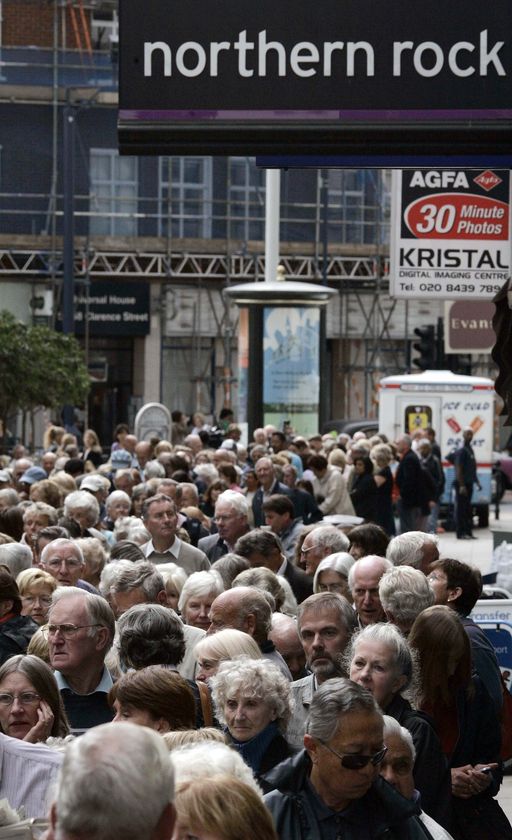
When global liquidity dried up, Northern Rock couldn’t cover its money market borrowings. It asked the Bank of England for money in 2007, at which point the Tripartite Authority gave it emergency financial support.

After the bailout news hit, customers Martin Upton”>ran on the bank, withdrawing about £1 billion, or 5% of Northern Rock’s total bank deposits, in one day, and up to £2 billion by September 17. Bank shares to fell 72%.

The run tapered off after the British Government said it would guarantee all Northern Rock deposits. In January 2008, Northern Rock sold its lifetime home equity release mortgage portfolio to JP Morgan, using the £2.2 billion gained from the sale to pay off part of its Bank of England loan.

In February, the government announced that it adding Northern Rock’s liabilities to the country’s national debt, now pegged at 45% of GDP. It was thus nationalized.

Action: An internal report released in March 2008 cited inadequate government supervision during the Northern Rock crisis, but blamed the bank’s collapse on its senior management.

Moral of the story:
Repackaging debt as assets in a fake nonprofit only works when the economy is going smoothly. Don’t build your entire business out of this practice and expect to survive.

7. Tulip Mania (The Netherlands, 1637)

Causes: The first speculative bubble on record revolved not around property or companies, but around tulip bulbs. After tulips were introduced by modern-day Turkey to Europe in the mid-1500s, people in the Netherlands grew especially fond of them, seeing them as a status symbol.

Tulips infected with a certain virus tended to develop spectacular colors, flames, and lines on their petals. These new varieties were given high-sounding names and coveted wildly by the population. In order to secure these fancy tulips in advance—tulips with the virus can take as long as 12 years to develop from seed to flower—a market developed around their trade.

Traders signed medieval futures contracts that guaranteed them tulips at the end of the season. Professional growers, meanwhile, were willing to pay more and more for the popular flowers. Some tulips were worth more than peoples’ annual wages.

In the 1630s, speculators, lured by tales of sudden riches, flooded the market. The Dutch government banned short selling of futures contracts several times in the 1600s to control the mania. It also created a formal market for purchase and sale of tulip futures, requiring traders to meet in taverns and pay a small fee for each trade.

Bulb prices climbed until early 1637, when tulip traders were no longer able to sell bulbs at inflated prices. Demand collapsed, leading to a drop in price. The tulip futures trade stopped.

Action: Tulip speculators went to the government for help. The government, in turn, permitted futures contracts to be voided with a 10% fee. Many futures holders voided their contracts, and bulb sellers were stuck with their inventory.

Moral of the story: People go crazy when they become convinced that they can get rich quickly. Even off a tulip bulb future.

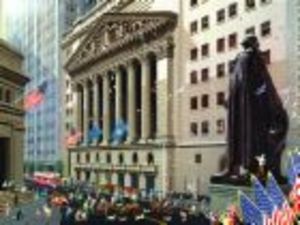
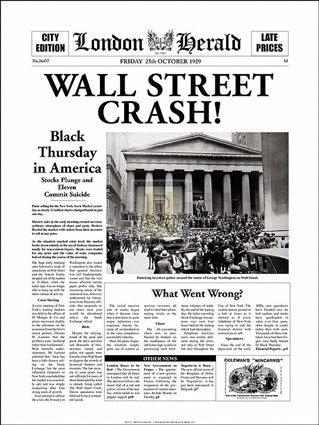
6. Wall Street Crash of 1929

Cause: In the late 1920s, hundreds of thousands of investors contributed to a speculative bubble in the stock market. Many went into debt to purchase stock, resulting in more than $8.5 billion in debt throughout the nation—more money than was in circulation at the time.

When the market turned bearish on October 24, 1929, investors panicked, causing a massive selloff that tanked the stock markets and contributed to the Great Depression of the 1930s.

To demonstrate confidence in the market, the Rockefeller family and the heads of major banks bought large quantities of stock. This move didn’t stop the panic. During the week of October 24, the market lost a total of $30 billion, more than the United States had spent on World War I.

The stock market crashed caused businesses to close, mass layoffs, and a rash of bankruptcies. An international run on the dollar resulted in increased interest rates, driving out around 4,000 lenders.

Action:
After an investigation, Congress passed the Glass-Steagall Act of 1933 (now repealed), mandating a separation between investment and commercial banks. They believed this would avert another dramatic panic sale. It didn’t—the Dow fell 22.6% in 1987—but, to date, the Great Depression that followed the 1929 crash hasn’t been repeated.

Moral of the story: Don’t panic. Many scholars now say that the 1929 crash didn’t cause the Great Depression, but certainly contributed to its severity. Public panic only makes situations worse than they already are.

5. The Japanese asset price bubble (1986-1990)

Causes: After World War II, Japan’s domestic policies encouraged people to save money. People put more money into banks, making it easier for companies to take out loans and lines of credit.

Using their new lines of credit, Japanese companies invested in capital resources, enabling them to produce goods more efficiently than international competitors. Japanese provided high-quality products at extremely competitive prices, becoming a major world economic power in the process.

At the same time, the yen steadily appreciated. Investors to make good money off financial markets. People used easy credit to develop property and buy homes, contributing to a speculative real estate bubble.

Real estate prices inflated, with some Tokyo properties selling at $139,000/square foot. Stocks prices seemed to have no ceiling at all. Reinvestment expanded the economy further. The Nikkei reached an all-time high of 38,957.44 in December of 1989.

Then, in the early 1990s, Japan’s bubble started to sink. Rather than a dramatic crash, real estate and stock values decreased slowly, leading to Japan’s “lost decade.” People started investing outside of the country; companies lost some of their competitive advantage internationally as a result. Low consumption rates coupled with lower output and employment meant steady deflation.

Action:
The government lowered interest rates to practically nothing, which did nothing to encourage Japanese people to put money in the banks. The government subsidized banks and businesses on the brink of failure, effectively propping up zombie organizations with little visible benefit to the economy. The Yen carry trade became one of the main ways people made money off their investments.

In 2003, the Nikkei finally started climbing again.

Moral of the story:
When bubbles grow, they’re wonderful in every way. When they sink—and they can sink, rather than popping—they can set the economy back more than a decade.

4. The .com bubble (1995-2000)


Cause:
In the mid-1990s, a new type of business emerged: The .com, a company either based solely on the Web or servicing the Internet, its people, and its technology. When early .coms’ stock values shot skyward, venture capitalists jumped aboard en masse to finance Internet startups.

A .com’s lack of a viable business plan didn’t stop many VCs from throwing in money. Investors and startup executives assumed that once a .com had peoples’ attention, the money would come organically in the future.

Speculators jumped in, creating a market full of wildly overvalued startups. Lavish spending and astronomical publicity campaigns followed. .coms burned through their VC money, positive it would come back soon. Day trading became a relatively common way to make fast money.

In 2000, the NASDAQ began to trend downward, leading to what’s known as the .com bust.

Action:
Though the government didn’t address .com startups or speculation, its policies and timing may have contributed to a loss of confidence. Between 1999-2000, the Fed increased interest rates six times in order to reign in the economy. Around the same time, a flurry of government investigations stalled corrupt business practices.

For example, around the same time the NASDAQ began its slide, Microsoft was declared a monopoly. Major telecommunications companies, such as MCI Worldcom, toppled under debt and management scandals. Regulators put the financial industry under fire for misleading investors during the .com boom. Famously, Enron collapsed after investigators uncovered an accounting scandal.

The Sarbanes-Oxley Act was passed in 2002, laying out far tougher transparency and accountability standards for public companies.

Moral of the story:
The market, your favorite bipolar uncle, likes to celebrate wildly when he finds out about new technology. Just be sure to steer clear of him when his mania turns into prolonged, howling grief.

3. 1997 Asian Financial Crisis (1997-1999)


Causes:
In the years leading up to the crisis, Southeast Asia was a hot international investment destination. ASEAN countries’ high short-term interest rates gave foreign investors favorable rates. Capital flooded into the region.

Asset prices increased, and growth rates in the early 1990s were as high as 12% of GDP, leading analysts to refer to the phenomenon as the “Asian Tigers” and “Asian Economic Miracle.”

At the same time, Thailand, South Korea, and Indonesia ran huge deficits. They borrowed quite a bit of money externally; keeping their own interest rates fixed encouraged this behavior. This left them vulnerable to changes in foreign markets.

In the early ‘90s, foreign investors turned away from Asia. Higher US interest rates valued the dollar up, which in turn made Southeast Asia’s exports less competitive (their currencies were pegged to the US dollar). Southeast Asian exports slowed in early 1996, fueled at least in part by China’s increased competitiveness in the export market.

What caused the crisis from here is subject to rampant debate. Some say that policies leading to large amounts of credit pushed up asset prices, which then collapsed, leading to massive debt defaults (kind of like the subprime crisis).

International investors panicked and withdrew credit. To keep the region attractive to foreign investors, ASEAN governments jacked up interest rates and bought up excess domestic money using foreign reserves. As a result, the governments’ central banks started running out of foreign reserves, while capital continued to drain from the region.

In 1997, Thailand’s government decided to float the baht, unleashing what’s now known as the Asian Financial Crisis. Regional currencies depreciated, meaning liabilities denominated in terms of foreign currency grew even more expensive in domestic terms. Entire economic sectors melted down, while people fell into poverty. Stock markets and currencies rapidly devalued. Politics destabilized, with executive resignations and an increase in extremist groups. The region seemed to melt down in the blink of an eye.

Actions: The International Monetary Fund created bailout packages dictating reforms in exchange for debt defaults. The reforms included cutting government spending, allowing banks to fail, raising interest rates, and becoming more transparent.

The IMF’s actions had questionable results, leading to a backlash against powerful international NGOs that continues today. Some say the crisis in Asia also contributed to the recent United States housing bubble.

Moral of the story:
When things crash, rich people may interfere, offering money in exchange for an agenda. That doesn’t mean their agenda is right, or even useful. Moral #2: Financial meltdowns can happen at the speed of light.

2. Russian financial crisis (1998)

Causes: In 1993, the Russian government came up with inflation-free short-term treasury bills, known as GKOs, to finance the country’s deficit. GKOs were traded on currency exchanges. Though mostly state-owned, roughly 1/3 of funding came from foreign speculators, which they attracted through high interest rates. The government used proceeds from sales of new GKOs to pay off interest on matured bills—a classic Ponzi scheme.

In June 1997, looking to raise capital, the government increased GKO interest rates to 150%. By the beginning of 1998, GKO interest payments comprised more than half the federal government’s revenue. They became large domestic banks’ main source of revenue.

Meanwhile, the government owed workers roughly $12.5 billion in unpaid wages. It was also making more money from GKOs than from taxes. Investors lost confidence in the Russian government when they put all the pieces together, selling Russian securities and rubles. The Central Bank tried unsuccessfully to stabilize the ruble by spending an estimated $27 billion of its United States dollar reserves.

In August 1998, Russia’s markets collapsed. Investors, fearing a devaluation of the ruble and a debt default, panicked, leaving the market with a 65% drop in one day. As a result, several major banks closed, and inflation increased. It also eradicated the nascent middle class by eating through peoples’ bank savings.

Actions: The government cut spending on social- and municipal services. Fortunately, oil prices skyrocketed after 1999, facilitating a quick recovery.

Moral of the story: Don’t anger people while financing yourself with a Ponzi scheme. It ends up being much more expensive in the long run.

1. Argentine economic crisis (1999–2002)

Causes: Agentina had a history of volatility when the 1980s Latin American crisis struck. The import-dependent country was running low on US dollars, a currency that people were entitled to convert their pesos into if they felt like it (this was a “safe” option for many people).

The country also had a history of runaway inflation and associated loss of confidence in its currency. Meanwhile, the government spent lavishly on itself while ignoring the country’s crumbling industrial infrastructure.

In the 1980s, Mexico and Brazil, major Argentinian trade partners, suffered economic crises that spread through Latin America. Brazil’s real was devalued in 1999, hurting Argentine exports; at the same time, the dollar was revalued, delivering the Argentinian peso another blow.

In 1999, the country entered a 3-year recession. The government did not devalue the peso or unpeg it from the dollar, making the crisis worse.

The recession deepened. Investors ran on banks for dollars, which they then sent abroad for safety. In response, the government more or less froze everyone’s bank account.

Citizens protested in major cities, eventually starting fires and destroying property. Violence and fatalities ensued. In 2001, the government collapsed. People bartered for goods because they lacked cash. Business shut down. Many people eked out a living by scavenging cardboard for recycling plants.

Action: The government at first tried to set up a third currency between the peso and the dollar, but this failed. It then mandated that all dollars in banks be converted into pesos.

The exchange was left to float, leading the peso to depreciate. Exports became more competitive. The government tightened its tax policies, improved social welfare, encouraged business growth, and put reserve dollars up for sale on the market. As worldwide demand from Argentinian agricultural products increased, the country grew a trade surplus. It continues to struggle with inflation, however.

Moral of the story:
Freezing bank accounts is a really bad idea.


source: businesspundit.com

Fort Lauderdale Blog & Real Estate News

Rory Vanucchi

RoryVanucchi@gmail.com

www.LasOlasLifestyles.com

www.FortLauderdaleLiving.net


Once Sizzling, China’s Economy Shows Rapid Signs of Fizzling

By DAVID BARBOZA
Published: November 6, 2008
SHANGHAI — Each new forecast of China’s economic fortunes predicts slower growth than the forecast that preceded it.

Just as China attained supercharged growth that astounded much of the world, it appears to be slowing more sharply and more quickly than anyone anticipated.
“It’s tough to be optimistic,” said Stephen Green, an economist at Standard Chartered Bank in Shanghai. “The three engines of growth — exports, investment and consumption — have all slowed down.”
The signs are so troubling that last week Prime Minister Wen Jiabao warned that this year would be “the worst in recent years for our economic development.”
A series of government reports released over the last few weeks indicated that China’s export juggernaut was moderating. Real estate construction projects are being suspended. Consumer confidence is in decline. And many factories in southern China are closing, putting tens of thousands of migrant laborers out of work.

Some Chinese companies have even reported that Christmas orders — which were supposed to be placed in late summer or early fall — were down 20 percent this year, as big retailers and toy marketers grew gloomy about the holiday season.
Until recently, many economists had insisted that China was insulated from the global financial crisis rippling through the United States and Europe, and that the Chinese Communist Party had the tools to keep the economy chugging along. But newly released data suggests that nearly every sector of the economy is slowing and credit is tightening in a nation that has grown accustomed to sizzling hot growth.
While few economists expect China to fall into recession, analysts are forecasting the worst growth in more than a decade, with the economy expected to expand by as little as 5.8 percent in the fourth quarter this year, down from about 11 percent in 2007.
Analysts worry that a sharp downturn could undermine the country’s already weakening investment climate and impair some of China’s biggest banks, which have bankrolled much of the boom.
Beijing worries that if growth slows to 8 percent or less, not enough jobs will be created in a country that is rapidly urbanizing — and that could lead to social unrest.
To prevent that, the government is preparing a large economic stimulus package, pushing new infrastructure projects, offering aid to exporters and searching for ways to prop up the nation’s severely depressed stock and real estate markets.
Less than six months ago, the government’s chief concerns were soaring inflation and an economy that was growing too fast.
Now, inventories are piling up around the country as domestic and foreign demand for Chinese goods slackens. In southern China, the government has had to step in to aid migrant workers after factory closures.

Indeed, when the Canton Trade Fair ended this week in the city of Guangzhou, orders at one of the biggest events for Chinese products were down significantly, and so were visitors, according to participants.
But it is not just export-oriented factories that are being hit. Companies that sell in China are also suffering because investment projects are being postponed and consumers are pulling back on major purchases.
After five years of growth over 10 percent, China’s growth rate has decelerated for five consecutive quarters, dropping from 12.6 percent in the second quarter of 2007 to about 9 percent the third quarter of this year.
That growth rate is still strong, but economists say the downturn began sharpening in the last two months. At many factories, large Christmas orders were canceled.
Earlier this week, the government announced that China’s purchase management index, which is used to measure the country’s economic performance, fell in October to its lowest level since it began compiling data in 2005, indicating that orders of all kinds had fallen sharply.
Auto sales in China have plummeted this year. Air travel is in decline. Property sales have dried up, and weakness in the property market is hitting the makers of steel, cement and glass.
“There is a nose dive in real estate construction in south China and east China, the two real estate boom areas,” said Yang Dongsen, a cement industry analyst at Merchant Securities. The real estate slowdown is expected to affect retail sales, which for the last few years had been lifted by new-home buyers purchasing appliances, decorations and other household goods.
It does not help that China’s stock markets have also collapsed, after a stunning rise in 2006 and 2007. Share prices in Hong Kong are down about 50 percent, and the Shanghai composite index has fallen 67 percent this year, wiping out nearly all the gains it had made in the previous two years.
Many economists say they believe that government stimulus packages will stabilize China’s economy and prevent an even steeper decline in growth, and that the economy could pick up steam by the second half of 2009.
Still, many economists say times have changed for a while.

“Don’t count on China to get back to double-digit growth for the next few years,” said Dong Tao, an economist at Credit Suisse in Hong Kong.
Keith Bradsher contributed reporting from Guangzhou. Chen Yang contributed research.

source: ny times


Rory Vanucchi
Fort Lauderdale Blog & Real Estate News
RoryVanucchi@gmail.com

www.LasOlasLifestyles.com
www.FortLauderdaleLiving.net

Dubai prices rising as fast as buildings


Published: October 16, 2008

Richard Waryn has lived in Dubai for only two months but he already is certain that the glitz capital of the Mideast lives up to its go-go reputation. What he is not so sure about is whether to sink his money into the sleek apartment towers springing up everywhere.

With property prices up 40 percent this year - and critics warning that a slide is coming - other potential buyers are asking themselves the same question.

"There are just too many developments under construction that are coming online in the next two or three years," said Waryn, an American executive who moved to Dubai from London. "The supply and demand balance are going to be out of whack and the prices will come down."

A Morgan Stanley report predicted a 10 percent decline in prices by 2010 as the supply of new properties outstrips demand. But that view is disputed by other analysts and high-end developers, who say Dubai still is not building enough housing to accommodate a population that is growing by 7 percent a year. Of the emirate's population of 1.5 million, about 75 percent are expatriates like Waryn.

A key question facing the property market is whether the still-booming regional economy can withstand the economic turmoil gripping other parts of the globe. Those worries have sent Middle East stocks tumbling in the past two weeks to multiyear lows.

With oil prices falling, further concerns were raised late last month when the Central Bank of the United Arab Emirates made $13.6 billion available to the country's banks. "There appears to be a bit of a liquidity crunch going on with the central bank moving to put money in the market," said Sean Gardiner, head of regional research for Morgan Stanley. "It may make some of the smaller developers struggle to find financing."

Still, most analysts say Dubai is well positioned to ride out the global downturn. Investors expressed confidence that Middle East real estate markets would outperform others in the world over the next two years, according to a survey released Oct. 7 by the real estate agency Jones Lang LaSalle.

At Cityscape, Dubai's splashy annual property fair held last week, several plans for large-scale projects were announced, including a $39 billion tower that developers said will be the world's tallest. Dubai already is building a $20 billion tower, Burj Dubai, that has been expected to take the world's tallest title when it is finished next year.

Some analysts warn that a drop in real estate prices is inevitable if Dubai does not curb speculators who, seeking a quick return, buy and flip their interest in so-called "off-plan" units - projects that are still on the drawing board.

Developers sensitive to the criticism are taking steps to reassure investors and some even have stopped selling off-plan units. Others are targeting long-term buyers not only with promises of higher returns than can be obtained in Western capitals these days, but also with glossy promotions touting the lifestyle benefits of tax-free Dubai.

One project being heavily marketed is Culture Village, a 110,000-square-meter, or 1.2 million-square-foot, complex set to open in 2010 hugging the picturesque Dubai Creek. Along with the usual apartments and restaurants there also are schools planned for the arts as well as the 25,000-square-meter Museum of the Middle East, or Momena.

"Today we realize in Dubai that we should expose our past, our culture, our rituals, our dance. That's what was missing," said Yaqoob Al Zarooni, vice president of the government-owned Dubai Properties, which is building Culture Village. He was speaking at an event last month at the Ritz Hotel in Paris to introduce Babil, one of the complex's four midrise residences. The 51 studio to two-bedroom apartments, all of which have been sold, started at $414,100 and were aimed at European, American and Japanese buyers.

A 145-square-meter, two-bedroom apartment selling for $1.25 million at Babil would cost twice as much in prime areas of New York. In London, where housing prices are down 4.3 percent this year and expected to fall further, it still would cost six times as much.

"There is still no place else where buyers can continue to make these returns," said Shirley Humphrey of Harrods Estates, which is marketing the Babil project.

For now, despite concerns about the global economy, it appears the questions most Dubai residents are asking is when and where to buy.

Trends include developments pushing far into the desert and projects with themes like Dubai Properties' Mudon, a sprawling complex of five minicities, including a mock Marrakesh and Cairo.

Everyone, it seems, is in on the game. Waryn and a friend said they were stunned when, over dinner at the Dubai Marina, their waiter tried to sell them his option in a two-bedroom apartment in the Burj Dubai tower.

"It's like Las Vegas on steroids, without the gambling," said Waryn, 45, managing director for a private equity investment group.

In the end, Waryn and his wife, Liz, a lawyer, opted to rent a 550-square-meter duplex penthouse with private pool and terraces overlooking the sea. The $100,000 annual rent seemed a better deal than buying an equivalent property for about $4 million, although he said they still may buy an investment property.

So far, they are thrilled with life in sunny Dubai, where Jumeirah Beach is steps away and there are things to do with their 21-month-old daughter, Alexandra. "It's kind of the antithesis of where London and New York are right now," Waryn said. "The Gulf is a very attractive place while the rest of the world is doom and gloom."

source: iht


Rory Vanucchi

Fort Lauderdale Blog & Real Estate News

www.LasOlaslifestyles.com

www.FortLauderdaleLiving.net

RoryVanucchi@gmail.com


ECB Watch: Benchmark rate expected to fall to at least 2% by mid-2009

By Finfacts Team
Nov 7, 2008 - 7:56:12 AM

ECB Watch: Following the decision of the European Central Bank to cut its benchmark rate to 3.25% on Thursday, the rate is expected to fall to at least 2% by mid-2009.

If the rate falls to 2%, borrowers on trackers, will in particular gain.

As banks charge their customers about 1.25% above the ECB rate, depending on the type of mortgage.

Borrowers could gain a €400 reduction in monthly payments from the cuts that began in October.

A homeowner on a €300,000 tracker mortgage will benefit from a monthly repayment fall by €90 from Thursday's cut, in addition to the October cut, which also reduced the repayments by another €90.

The IMF expects the advanced economies to have their first full-year contraction in 2009 since 1945.

The reduction in mortgage costs should give the Government some courage to tackle the issue of public sector pay as private sector workers will in general get no rises and be at risk of unemployment.

The following is analyses on the rate outlook from 3 bank economists.

AIB economists led by Chief Economist John Beggs:

The ECB finally sees the light:

The European Central Bank cut rates by 0.5% today, bringing the total reduction in official rates in the eurozone to 1% in the past month.

It is hard to believe that the ECB hiked rates as recently as July. There has been a sea-change in its thinking on monetary policy since then, brought about by an abatement in inflationary pressures as oil prices collapsed and the eurozone economy hit recession, as well as worries about the deepening financial crisis.

It is clear that the ECB was not forward looking enough in terms of its monetary policy decisions in the earlier part of the year.

The summer rate hike stunned markets, given the worsening economic backdrop and fragility of the financial system. It contrasted with the policy easing of the Fed and BoE in H1 2008. The ECB, though, has been forced into a policy reversal and is now cutting interest rates rapidly to bring monetary policy more into line with economic realities.

The ECB did not attach much weight until recently to the turmoil in financial markets and its implication for the real economy.

While the ECB tried to distinguish between the operation of monetary policy for price stability purposes and money market operations, the lines became increasingly blurred. The rise in interbank rates and seizure in credit and money markets resulted in a sharp tightening of financial conditions that was completely inappropriate in an already weakening economy, increasing the risk of a deep and prolonged recession.

Neither did the ECB pay enough attention to leading indicators showing a sharp weakening in economic activity.

The latest readings from these indicators, in particular the PMI surveys and EC’s economic sentiment index, are truly awful. GDP contracted by 0.2% in Q2 and a decline of around 0.1% may have occurred in Q3. Leading indicators point to a marked fall in GDP in Q4. The eurozone economy, then, has been in decline for most of this year and the recession is likely to last until the middle of next year, judging by the continued downtrend in leading indicators.

With interbank rates still very high relative to official interest rates, it is quite clear that rapid and significant policy easing is required.

Three month interbank rates are still around 4.5% after today’s cut. Official rates need to be cut to very low levels to help bring down interbank rates, as has happened in the US. The ECB did consider cutting rates by 0.75% today. It was a missed opportunity for a bigger ECB rate cut as the BoE slashed rates by a whopping 1.5% today.

With inflation set to fall well below 2% next year, ECB President Mr Trichet hinted at his press conference today that further policy easing is on the cards, and another 0.5% rate cut seems likely in December.In the last cycle, ECB rates were eventually cut to a low of 2%. On that occasion, the economy managed to avoid recession. With the economy now in recession, inflation on the wane and interbank rates still elevated, ECB rates hould be cut to at least 2% in 2009.

Eurozone Economy In Recession

Eurozone GDP contracted by 0.2% in Q2 and data published since mid-year point to a continued deceleration in the pace of activity, indicating that the economy is in recession. The most recent data have been very weak, pointing to a marked contraction in GDP in Q4 and suggesting that the downturn in activity could last well into the middle of next year.

The EC’s economic sentiment index, a good lead indicator of economic growth, collapsed in October to 80.4 from 87.5 in September. This was the sharpest monthly fall on record and leaves the index at a 15 year low. The index has been in decline since mid-2007, when it stood at 111.6.

Meanwhile, the composite eurozone PMI fell to a record low of 43.6 in Octoberfrom 45.3 in September, well below its peak of 57.8 in June 2007. The October readings for both these indices, if sustained, point to a fall in GDP of around 0.3% in Q4. The contraction in GDP could be even greater if the indices continue to decline in the final two months of the year.

A marked fall is also evident in national surveys of business and consumer confidence, notably the Ifo index in Germany, INSEE surveys in France and ISAE index in Italy. The continuing sharp decline in these leading indicators in recent months is another sign that GDP growth is weakening further in the second half of 2008.

This is borne out by trends in manufacturing output and retail sales, which declined on an annual basis in July and August, and the marked slowdown in export growth over the summer.

The eurozone labour market has also weakened this year. The unemployment rate picked up to 7.5% in Q3 from 7.2% in the first quarter of the year. Employment rose by 0.2% in Q2 2008 compared to 0.5% a year earlier in Q2 2007. Survey data point to a continued weakening in labour market conditions. Meanwhile, inflation has started to ease, having picked up sharply earlier this year on the back of soaring food and energy prices. The CPI rate hit a historic high of 4% in July but had fallen to 3.2% by October following declines in commodity prices, especially oil. The CPI rate is set to continue on its downward path in the months ahead given the further fall in oil prices over the past month. The recession and rising unemployment will put downward pressure on core inflation. The CPI rate should decline to 2% next spring and 1% by next summer if the fall in oil prices in recent months proves sustained.

The growth in monetary aggregates is also decelerating. M3 grew by 8.6% y-o-y in September, down from 12.3% a year ago.

Growth in private sector credit slowed to 10% in September from close to 13% at end 2007.

Although declining, these growth rates are still elevated, but this may be because the current malfunctioning of credit markets puts greater reliance on banking finance, especially for corporates. Loan growth to households for example has slowed sharply to less than 4% y-o-y at this stage.

Overall, looking at the trend in the real economy, inflation and monetary aggregates, there seems little to stop the ECB from slashing interest rates to very low levels. Rates were cut to 2% in the last cycle. There is no reason why rates cannot be cut to this level again with inflation headed below 2% in 2009.

Simon Barry, Ulster Bank Capitals Markets:

ECB cuts by (only!) 0.50% as rates now headed to 2% or lower

ECB cut rates by another 0.50% today…
…this follows the 0.50% reduction in early October…
…so rates now stand at a two-year low of 3.25%, down from the recent peak of 4.25%...
…the ECB has never before cut rates by this much this quickly…
…though there was some disappointment that the cut wasn’t even bigger following the extraordinarily radical 1.5% cut from the Bank of England earlier today…
…a still highly fragile financial system and a rapidly deteriorating economic outlook provide the context for today’s move…
…while sharply lower oil prices also greatly help the outlook for inflation…
…further rate reductions are virtually certain in the period ahead including another 0.50% cut next month…
…rates now headed for previous low of 2%, maybe even lower


The ECB cut official interest rates in the euro zone by 0.5% today. Today’s move follows the 0.50% reduction announced as part of the co-ordinated global easing of interest rate policy on October 8th. ECB rates now stand at 3.25% - the lowest level in nearly two years – and down from the cycle peak of 4.25% reached in July.

The decision to cut rates was based on what Trichet referred to as the “alleviation of upside risks to price stability” – in other words an improved outlook for inflation. The improvement in the inflation picture has two clear drivers. First, the 60% drop in oil prices since July (from $147pb to $60 at present) will help produce a sharp decline in headline rates of inflation in the quarters ahead. Indeed, it looks as if HICP inflation (the ECB’s measure) could be as low as around 1.6% by next Summer, as the effect of lower oil and other commodity prices kicks in.

Second, incoming economic news, both from the euro area and the wider global economy, has been nothing short of horrendous of late. This week’s PMIs were a case in point. The October readings of both the manufacturing and services surveys hit new all-time record lows in the euro area, underlining how severe the loss in momentum has been in activity in recent months. Numbers out of Germany earlier today confirm the extreme weakness which is gripping the zone’s largest economy, with factory orders plummeting by a staggering 8% in the month of September alone – the biggest one-month fall since at least 1991. News from other major economies has also been exceptionally weak. Service and manufacturing PMIs from both the US and UK – two of the euro zone’s most important trading partners - have also collapsed in the past couple of months.

The weakness in domestic and external demand prospects featured prominently in Trichet’s statement. Notably, Trichet observed that the intensification and broadening of the financial market turmoil is likely to dampen global and euro area demand for “a rather protracted period of time”.

The global financial system has clearly been going through a period of unprecedented stress in recent weeks and months. But we can take at least some encouragement from the fact that the extreme distress in the capital markets, and the related pronounced weakness now affecting the major economies, continues to be met by an unprecedented response from policy-makers globally.

Today’s ECB move is another example of the determination of the authorities to prevent a catastrophic economic scenario. Since the ECB was formed in 1999, it has never cut rates by so much so quickly. At the beginning of the last interest rate cutting cycle in 2001, for example, it took the ECB four months to get rates down by 1%. This time they have done so in four weeks!

Today’s 0.50% move was in line with the prior expectations of most financial analysts. However, there was a palpable sense of disappointment in the markets at 12.45 when the ECB decision was announced following the extraordinarily radical 1.5% cut from the Bank of England earlier. The BoE’s decision was as laudable as it was audacious.

The ECB today missed an opportunity to deliver an even bolder move itself. But the sharp ongoing deterioration in the economic environment means that we shouldn’t have to wait much longer for the next instalment of policy easing. We expect another 0.50% cut at the December meeting, and rates look destined to get to the 2% low of the last cycle, if not even lower.

Austin Hughes, KBC Ireland - formerly IIB Bank:

  • ECB cuts for the second time in less than a month.

  • Rates likely to fall again in December as new forecasts will emphasise worrying scale of economic slowdown.

  • Changed reality of much poorer global growth and continuing credit market turmoil argue for aggressive ECB easing.

  • We think interest rates can fall to 2% in 2009 and possibly lower.

  • Lower rates will offer some much needed support to the Irish economy.

As the European Central Bank had effectively pre-announced today’s rate cut, most market interest focussed on (1) the size of the rate reduction and (2) any pointers as to future policy easing.

On a day when the Bank of England delivered a dramatic 150 basis point reduction and the Swiss National Bank also surprised by announcing an intermeeting cut of 50 basis points, today’s ECB rate cut of 50 basis points may seem disappointing. Mr. Trichet did indicate that the ECB Governing Council had considered a 75 basis point reduction and also hinted that rates would fall again in December by saying that he ‘didn’t exclude that rates could fall again’. By emphasising that the December policy meeting was ‘an important rendezvous’ because of the availability of new ECB staff Economic projections, Mr. Trichet is clearly holding out the prospect of a further rate cut next month.

Why not cut by more?

We think there are at least three reasons why the ECB did not implement a bolder rate cut today. First of all, it appears at least some at the ECB still harbour residual concerns about the inflation outlook. In our comment on the co-ordinated rate cut of October 8, we highlighted the ECB’s continuing and seemingly misplaced concern about ‘second round effects in price and wage setting’. While Mr. Trichet acknowledged today that there has been ‘a further alleviation of upside risks to price stability’, the opening paragraph of the press statement also suggests the ECB believes ‘they have not disappeared completely’. This may reflect some differences of thinking within the Governing Council. It could also be that the ECB might be excessively concerned about the looming high profile pay deal in the German engineering sector. Some at the ECB may even feel that the global response to the current downturn threatens an eventual if distant rebound in price pressures. However, it is very difficult to square the ECB’s lingering worries about inflation with the relevant evidence emerging on the economic outlook of late.

A second argument for cutting less today and easing again in December is that it can be delivered next month against the backdrop of new ECB staff projections that will show notably poorer growth prospects and a weaker inflation trajectory. If the ECB had cut more aggressively today, the presentation of dismal forecasts next month without an appropriate policy response might have put the ECB in an uncomfortable situation Mr. Trichet is now in a position to deliver a further Christmas present in the shape of another easing on December 4th.

Finally, it remains the case that the ECB has been very slow to recognise the scale of emerging downside risks to the Eurozone economy as well as the spill-over effect of the credit market turmoil on activity in the ‘real’ economy. Mr. Trichet emphasised today that circumstances had changed dramatically of late. However, the sharp slowdown evident in a broad range of Eurozone indicators since the middle of the year suggests a marked worsening of economic conditions that predates by some distance any impact from the failure of Lehman’s in September. Naively, the ECB seems to have believed that the Eurozone would be insulated from poorer economic conditions outside the single currency area. In addition, the judgement that ECB monetary policy and liquidity policy could be operated in entirely different directions for a prolonged period of time now looks fanciful. The implication of these errors is a slower policy response that may imply poorer Eurozone economic performance in 2009 than might have been the case as well as the possibility that ECB rates may need to fall further than if rates had been reduced earlier and not increased in July.

The ECB has fallen behind

Today’s decision by the ECB to cut policy rates by 50 basis points on the same day that the Bank of England cut rates by a massive 150 basis points underlines the relatively conservative nature of monetary policy in the Eurozone. Since the turmoil in markets began in August 2007, the US Federal Reserve has reduced it’s policy rates by 425 basis points, the Bank of England by 275 basis points and the ECB by just 75 basis points(two recent 50 basis point cuts preceded by July’s 25 basis point increase). Admittedly, Euro area rates were not initially as high as in these other economic zones but US policy rates are now far lower while UK rates are below their German counterparts for the first time since the middle of 1994. (Higher inflation, stronger growth and the greater importance of borrowing to the UK economy mean that UK policy rates have traditionally been higher than their continental European counterparts).

Of course it can be argued that the financial blow to the Eurozone economy is not nearly as severe as that to either the US and UK but we are now looking at the prospect of a severe global economic downturn that requires a forceful and speedy response.

History suggests an aggressive easing is likely

Faced with a sharp slowdown in growth and attendant downward pressure on inflation in 2001-2003, the ECB cut rates aggressively. That easing cycle lasted two years, encompassed 7 rate cuts and a fall in official rates of 275 basis points. Importantly, however, the ECB began it’s easing process a good deal quicker in the economic downswing. It is also the case that the current slowdown is likely to be a good deal more severe than it’s predecessor. Indeed, we now expect Euro area GDP to shrink by around 0.5% in 2009, the first full year decline in GDP since 1993 when activity shrank to 0.8%. Although the starting point for interest rates was notably higher in 1992, the German Bundesbank, effectively the Central Bank that ruled Europe at that time, reduced it’s key policy rates by 275 basis points in 1993. These comparisons argue the case for further sharp and speedy rate cuts even after today’s move.

Because (i) the global economy has been set on a sharply weakening path for some time (ii) evidence of a marked worsening of Eurozone economic conditions has been accumulating since the middle of the year and (iii) the financial market turmoil intensified sharply in September/October, we don’t think incremental changes to policy can be justified.

The ECB has now cut rates by 100 basis points in less than a month but we think further near term easing is likely. The current episode is more worrisome than the period surrounding the 9/11 terrorist attacks when the ECB reduced rates by 125 basis points in a little over a two month timeframe. As a result, we look for another 50 basis point cut in December and further easing through early 2009 that takes the main ECB refinancing rate down to 2 per cent by the middle of next year. The current economic downturn looks like being a good deal more severe than the slowdown that triggered the drop in ECB rates to 2.00% in 2003. We think the speed and extent to which money markets return to normality and the extent to which governments use fiscal policy to boost activity will determine whether a new all-time low will be seen in ECB rates in 2009.

What about Ireland?

The evidence of the KBC/ESRI Irish Consumer Sentiment Survey suggests that changes in interest rates are of critical importance to consumer confidence in Ireland. This is scarcely surprising. We estimate that every 1% drop in interest rates will boost the spending power of Irish personal borrowers by about €1.5 bio. Of course, there is some offset as personal savers will suffer a hit of about half this amount. However, as borrowers tend to have a higher propensity to spend then consumers, the prospective drop in interest rates alongside cheaper energy and food should provide some support to consumer spending in the coming year.

While it might appear that the Irish economy’s close relationship with interest rates is a relatively new one, history suggests otherwise. Periods of significant reduction in borrowing costs tend to be followed by stronger economic growth. Clearly, the sharp drop in interest rates that occurred in the late ‘80s contributed significantly to the subsequent economic upturn.

Similarly, lower rates coincided with an improvement in Irish economic fortunes in the aftermath of the currency crisis. The approach of EMU also saw growth accelerate as did the drop in borrowing costs between 2001 and 2003. This is not to say that interest rates are the key determinant of the performance of the Irish economy. However, a more favourable interest rate climate in 2009 may leave the outlook for growth a little less threatening than is now feared.


source: irish financial news


Rory Vanucchi

Fort Lauderdale Blog & Real Estate News

LasOlasLifestyles.com

FortLauderdaleLiving.net

RoryVanucchi@gmail.com

Nov 5, 2008

Obama advisor says "Ireland must wean itself from dependence on FDI" - Foreign Direct Investment

By Finfacts Team
Nov 5, 2008 - 5:13:29 AM


US chip giant Intel is Ireland's largest industrial employer and Ireland's biggest foreign direct investment project. Since 1989, Intel has invested over $7 billion transforming the 360 acre former stud farm campus in Leixlip, Co. Kildare into a state of the art manufacturing centre of excellence.

Senior economic advisor to Barack Obama and former US Under-Secretary of Commerce for Economic Affairs, Dr. Robert Shapiro said on Tuesday: "Ireland must wean itself from dependence on FDI," while addressing a seminar 'FDI: What's the Forecast?' hosted by UCD Business Schools. Shapiro along with Irish and international experts from Wyeth, Intel, CRH, Citibank and UCD explored the challenges facing Ireland in its fight to retain FDI (Foreign Direct Investment) and the solutions we must embrace to remain an attractive investment location for international firms.

Shapiro predicted that a highly skilled, English speaking workforce is the key to giving Ireland an advantage over all other states competing for FDI. He said, "Ireland is the greatest economic success story in the last fifteen years and it will continue to be an attractive site for FDI as long as it continues to provide the caliber of graduate that foreign investors have come to expect."

Commenting on what lies ahead for FDI into Ireland, Shapiro said, "Ireland must wean itself from dependence on FDI. A low corporate taxation rate is not the most important factor moving forward, it goes beyond that. The next stage is not FDI but a series of policies that actively promote spillovers from FDI corporations to Irish indigenous firms. The best way forward is for young Irish people to become entrepreneurs and force existing business to compete and become the best in the world. If you look at the Chinese model, FDI is a transitional strategy, not an end game strategy, that creates a lasting impact. The key to Ireland's next stage is to make the entire economy a modern economy and not one that depends on the success of foreign companies."

Shapiro said there is a “significant possibility” an Obama administration will change the current tax rules, under which US companies pay tax on overseas earnings only when profits are repatriated.

However, he told the conference“there will be no seismic change in flows of FDI to Ireland or anywhere else as a result of the changes.”

After 15 years of the Celtic Tiger, foreign-owned companies, mainly American, are responsible for 90% of Irish exports. The windfalls of the construction boom, went into commercial property overseas rather than providing a base for nurturing Irish exporting enterprises.

"The ability to develop ideas is the single most critical factor and source of wealth and growth for advanced economies today, replacing physical assets and this is what Ireland needs to focus on," Executive VP of Wyeth Biotech, Dr. Michael Kamarck said, increased costs are starting to eliminate the advantages of Ireland's 12.5% business-friendly rate, "Utility costs have increased 100% in the last couple of years. This, plus increased healthcare costs, erode the tax advantages of doing business here and will result in employment being cut. It will be important to make sacrifices to keep Ireland an attractive location for FDI."

On what Ireland could do to remain a competitive location for FDI, Kamarck said, "You can beat a zero tax rate. If you look at Puerto Rico, it has increased its volume based R&D tax rate to 50%. You can provide tax credits for investment in Ireland and continue to invest in education. We need talent that can increase efficiencies in processes."

Jim O'Hara, General Manager, Intel Irelandagreed saying, "Ireland must be more competitive - increases in energy and utility prices and wages will be offset by the numbers employed."

Aidan Brady, Country Officer, Citibank Ireland agrees that countries must reconsider their approach to FDI saying, "Globally, industry will have to rethink models. Consolidation will mean major job losses of about 15-20% across the board."

Shapiro forecasted that,
"Our society will not tolerate on extended period of stagnant incomes – we are looking at the prospect of very ugly politics unless government can slow the rate of increases in energy and healthcare costs. If limits are not set, no society in the world will be able to meet the fiscal challenge of healthcare and pharmaceutical costs increase in the next 15 years. Government needs to be fair but brave in their policies."

Kamarck discussed his perspective on R&D in Ireland saying, "You are fighting an uphill battle to bring together research – there is an alphabet soup of agencies working on this in Ireland and to outsiders it may be viewed as unfocused. Ireland needs more focused R&D to put Irish universities in not only the top 100, but the top 25 in the world. We have got to form a world class university. To do this requires more direction and collaboration to generate worldwide academic centres of excellence. This will involve shocking uncomfortable change in choosing an aggressive strategy."

Considering the potential for Chinese investment in Ireland, Jim O'Hara, General Manager, Intel Ireland said, "A great opportunity for Ireland is to become a turn-key solution to enter Europe for Chinese firms. Ireland is very well versed in dealing with Europe. We could turn this into a massive opportunity. Ireland only needs a very small piece of the worldwide FDI pie to be very successful. We can offer expertise to China and many others to enter Europe, to establish their brands and gain financial, IP and legal support. We cannot get soft on climbing up the value chain and say manufacturing is not suited to the Irish economy. This would be a great mistake. It is much harder to compete at the high-value end of the value chain and the notion that developing nations will start at the bottom of this chain is nonsense. Irish institutions must be geared towards outputs in IP, with a focus on creating these, not just protecting them."

Paul Haran, Principal of the UCD College of Business and Law and former Secretary General of the Department of Enterprise, Trade and Employment, "Ireland must be the solution to other people's challenges, providing solutions that are superior to those provided by other economies. It has been a team effort; 'team Ireland' has made Ireland."

source: irish financial news


Fort Lauderdale Real Estate Blog & Homes For Sale
Rory Vanucchi
RoryVanucchi@gmail.com